Environmental compliance reporting · Belarus
POD environmental journals
POD journals that calculate, carry over and print themselves
The task
An ecologist keeps POD-6, POD-7 and POD-8 journals for several enterprises: volumes of water abstracted and discharged, and masses of pollutants. Each source has its own calculation method under the national environmental code — a meter, rainfall depth, electricity consumption, pump capacity; flow from one form carries over into another with unit conversion and its own rounding; annual volumes are checked against permit limits, and the statistical report is due by 10 February. All of it lived in Excel and on paper, where one wrong digit runs through the whole year. The system had to be built so that air and waste would later stand on the same frame as water.
Problems we solved
Every water source has its own calculation method, and the formulas were worked out by hand in a spreadsheet.
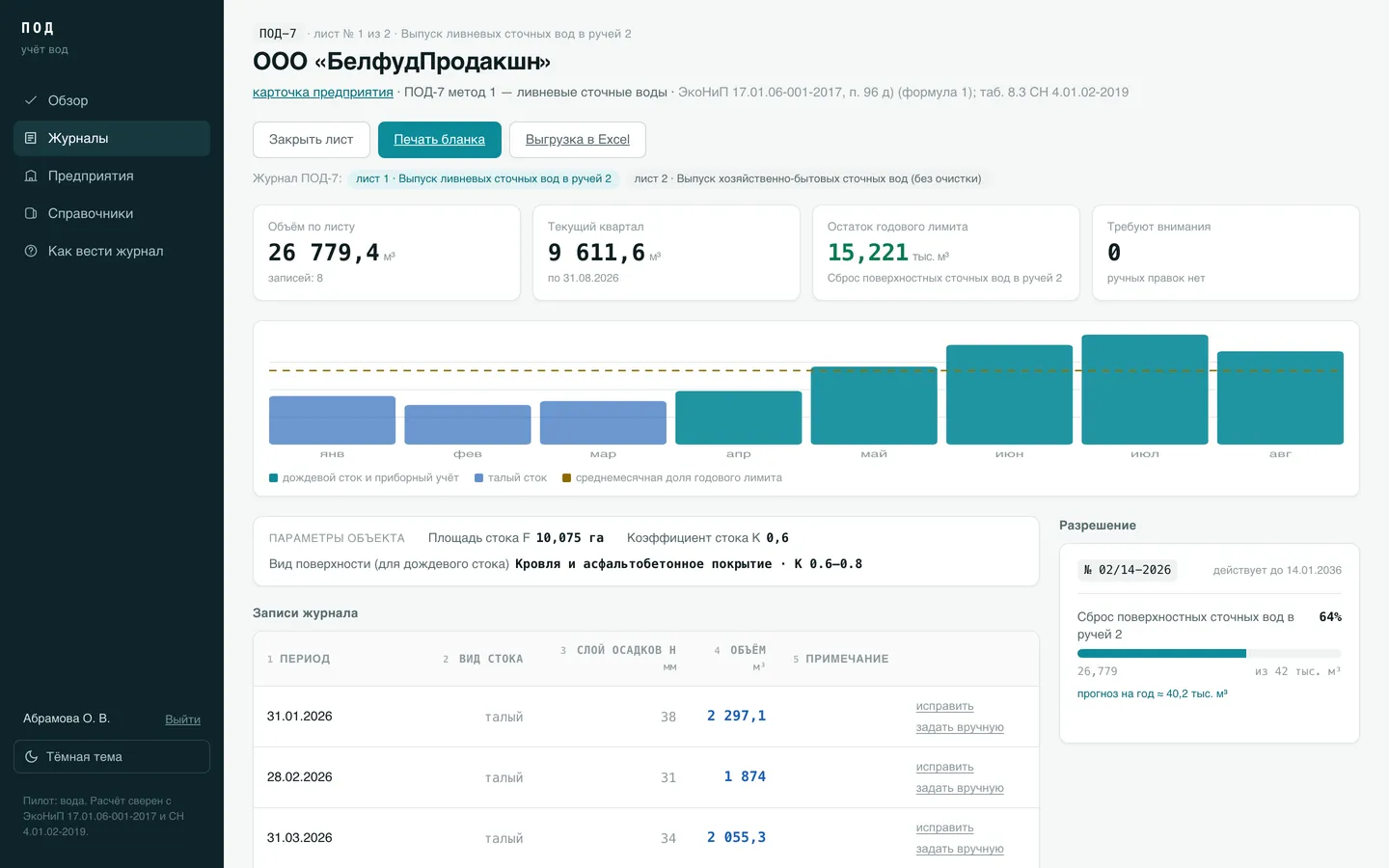
A registry of calculation methods: eleven formulas from the regulations, each citing its clause. The input fields come from the registry, runoff area and coefficient are taken from the object’s record as of the entry date, and the volume is calculated as you type.
Data moves between forms by hand: different units, different rounding, easy to get wrong.
Carry-over is a separate layer: quarterly flow is collected from the outlet’s POD-6 and POD-7 sheets, units are converted only at the boundary between forms, and rounding rules are set per form and per column.
Correcting a past month drags the quarter, the pollutant masses and the annual total along with it.
Editing an entry recalculates the whole chain forward: later months on the sheet, linked sheets and POD-8 rows. The history shows what a person corrected and what recalculated itself, with author and timestamp.
An extra digit in a meter reading looks like an ordinary entry and travels into the report.
Before saving, the system compares the volume with what is normal for that sheet and warns when it differs several times over; the entry keeps a flag. For weather-driven methods the threshold is looser — the spread there is natural.
Meter verification dates, permit expiry and unfilled months were kept in someone’s head and a notebook.
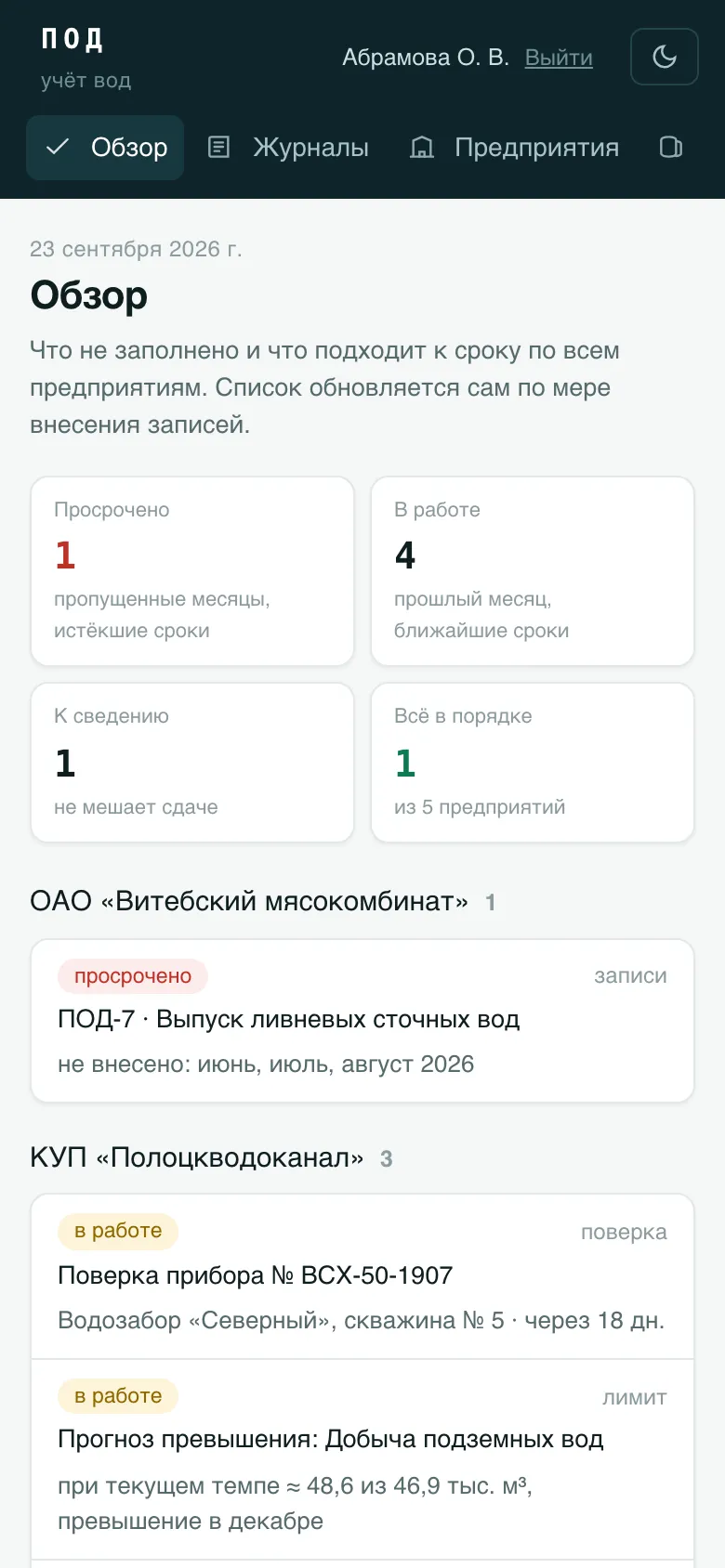
An overview on the home screen: unfilled months and quarters, upcoming meter verifications, expiring permits, a forecast of exceeding the annual limit at the current pace, and a reminder to close the year by reconciling the enterprise’s letter on water-use purposes.
Substances, concentrations and sampling dates are retyped into POD-8 from lab reports by hand.
A lab report is uploaded as a PDF or a photo: the AI extracts the measurements and proposes a substance from the catalogue, while the code, the number, the unit and the quarter are verified deterministically. Only the rows the ecologist confirms are saved; the report stays attached to the sheet.
What we did
- A calculation core built on the environmental code: eleven methods — meter, rainfall depth, electricity, pump capacity; every formula covered by a test against the ecologist’s own filled-in journals
- POD-6, POD-7 and POD-8 blanks printed to PDF in the approved layouts, plus export to Excel
- A deadline overview: unfilled months and quarters, meter verifications, permit expiry, a forecast of exceeding the annual limit
- One journal per enterprise with sheets per facility and outlet: replacing a meter closes a sheet and its total carries over to the next one
- Flow carried between forms with unit conversion and rounding by each form’s rules
- Versioned reference data citing its legal basis: runoff coefficients, rainfall for 112 localities, 465 substances and quality indicators
- Lab report recognition: the AI extracts substances and concentrations, the ecologist confirms the rows before they are saved
- Password sign-in, authorship on every change, documents attached to sheets and enterprises — lab reports, verification certificates, letters
- One-command deployment: database, application, HTTPS and daily backups of the database and the documents
How it looks